"We already have a WhatsApp chatbot."
We hear this on almost every call with a D2C founder. And it usually means one of three very different things. Some brands have a menu that says "Reply 1 for orders". Some have an AI bot that answers from their FAQ page. A few have an agent that can actually look things up and sell.
From the outside they look the same: a green chat window and an instant reply. But they do very different jobs, and knowing which one you have explains a common puzzle: why your WhatsApp gets lots of messages but few sales.
This guide explains the three types, shows how each one handles real shopper questions, and helps you decide what your brand needs.
The three kinds of WhatsApp automation
1. The menu bot (rule-based)
"Hi! Reply 1 for order status, 2 to browse products, 3 to talk to us."
A menu bot follows a fixed script. Every path is decided in advance by whoever built the flow.
Good at:
- sending order confirmations and shipping updates;
- simple, predictable journeys ("track my order" → enter order number → link);
- being cheap and easy to control.
Where it breaks:
the moment a shopper types a real question. "Is the blue one available in M?" doesn't match any button, so the bot replies with the menu again. Shoppers learn quickly to type "3" or give up.
2. The AI chatbot (FAQ bot)
An AI chatbot uses a language model to understand free text. You give it your FAQ page or website content, and it answers questions in natural language.
Good at:
- understanding questions however they're phrased, including Hinglish and typos;
- answering general questions: shipping times, return windows, how to use a product.
Where it breaks:
it usually has no connection to your live catalog, stock, prices or orders. So it answers in general terms ("We have many great options for dry skin!") or, worse, it guesses: a price from an old page, a size that sold out, a delivery date nobody promised. The reply sounds confident, which makes wrong answers more damaging.
3. The AI sales agent
An AI sales agent also uses a language model, but it is connected to tools and data: it can search your catalog, look up an order, read today's offers, and decide when to hand the chat to a person. It works inside rules you set.
Good at:
- helping a shopper choose: it filters your catalog by what they say they need and shows 2–3 real products with prices and links;
- answering order and policy questions from your actual data;
- taking routine questions off your team;
- handing over cleanly when a person is needed.
What it needs:
to be connected to your store and set up properly. That's where most of the work is, and why setup support matters when you choose a vendor.
Side by side: five real shopper messages
| What the shopper sends | Menu bot | AI chatbot | AI sales agent |
|---|---|---|---|
| "Where is my order #1042?" | Sends a tracking link, if that flow exists | "Please check your email for tracking details" | Looks up #1042 and replies: "Shipped yesterday, arriving Thursday. Here's the tracking link." |
| "Something for dry skin under ₹800?" | Shows the menu again | Gives generic skincare advice | Shows 2–3 matching products under ₹800 with photos and prices |
| "Is size M in stock?" | ❌ | Often guesses, or says "please check the website" | Checks the live catalog and answers yes or no, with alternatives if not |
| "Can I return a sale item?" | Sends the policy page link | Paraphrases the policy, sometimes wrongly | Answers from your policy, and hands to your team if it's an exception |
| "This is the third time I'm asking!!" | Shows the menu again | Keeps replying politely | Hands to your team straight away, with the full chat attached |
The last row matters more than it looks. An angry shopper who gets another automated reply becomes a one-star review. An agent that recognises the moment and steps aside keeps the customer.
The real difference: what surrounds the AI
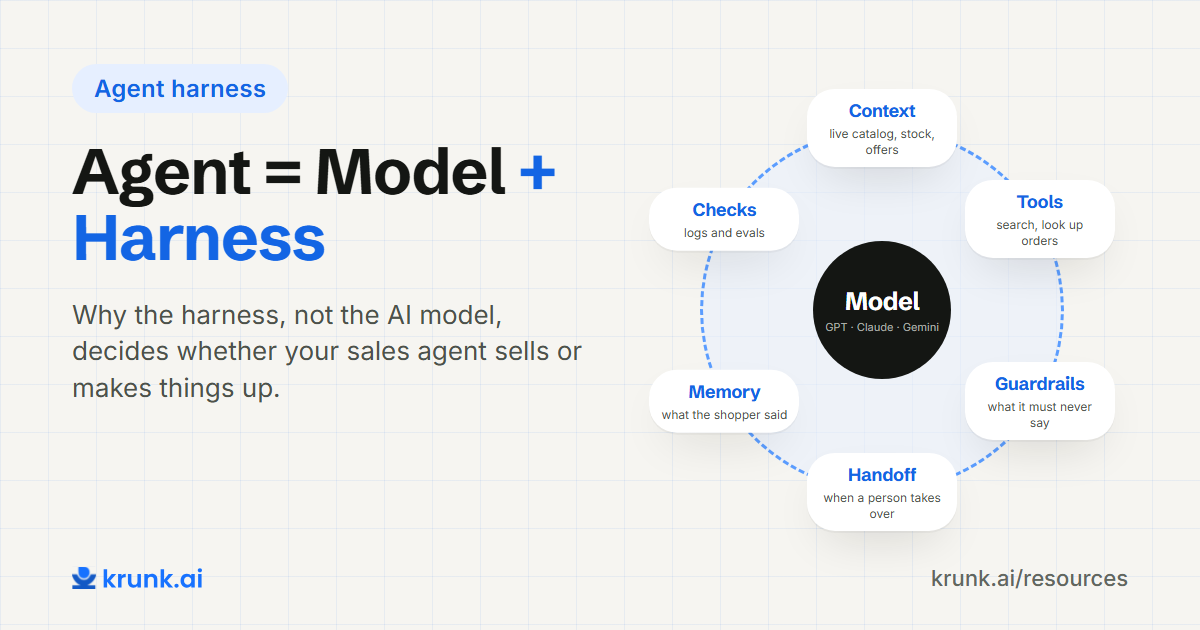
It's tempting to think an AI sales agent is just a "smarter chatbot" with a better model. It isn't. Most AI chatbots and AI agents use the same handful of AI models.
The difference is everything around the model:
- what data it can read (live catalog, stock, offers, orders, policies);
- what actions it can take (search products, check an order, apply an offer);
- what rules limit it (what it must never promise or claim);
- when it stops and hands over to a person;
- what it remembers from earlier in the conversation.
AI builders now call this layer the agent harness. Same model, different harness, very different results. What is an agent harness? →
Which one does your brand need?
There's no single right answer. It depends on what your shoppers actually ask.
A menu bot is fine if:
- most WhatsApp messages are order updates you send out;
- shoppers rarely ask product questions before buying;
- you sell only a handful of products.
An AI chatbot works if:
- most questions are general (shipping, returns, how-to);
- your catalog is small and rarely changes;
- you don't need live stock or order lookups.
You need an AI sales agent if:
- shoppers ask product questions before they buy ("which one for…", "is it available in…");
- you have many products, sizes or variants;
- "Where is my order?" eats hours of your team's day;
- you run sales, and prices or offers change often;
- you want WhatsApp to bring in revenue, not just deflect questions.
Quick check: look at your last 50 WhatsApp conversations. Count how many were product questions and how many were order questions. If more than a third are product questions, a menu bot or FAQ bot is leaving sales on the table.
The one-message test
Send this to your own WhatsApp number from a personal phone:
"Something for [a real customer need] under ₹[price], in stock in [size]?"
- A menu bot will show you its menu.
- An AI chatbot will give you general advice.
- An AI sales agent will show you products you actually sell, that are actually in stock, at that price.
If yours can't answer that one message, it's answering WhatsApp but it isn't selling on it.
5 questions to ask any WhatsApp AI vendor
- Does it read my catalog live, or from a copy I upload? A copy goes stale the day you change a price.
- Can it check real order status? Ask to see it look up an actual order in the demo.
- What does it do when it doesn't know? The right answer is "it says so and hands over", not "it always answers".
- Can I read every conversation and take over at any time? You should never be locked out of your own customer chats.
- Who sets it up, and how long does it take? Ask who reviews the first weeks of real conversations and fixes wrong answers.
Where Krunk fits
Krunk is an AI sales agent for D2C brands. It connects to your Shopify store (catalog, stock, orders and discounts sync automatically), answers on WhatsApp, Instagram and your website from one inbox, follows your brand's rules, and hands chats to your team when it should.
We set it up for you, and every plan starts with a 1-month free trial.
Next step
See the WhatsApp AI agent →FAQ
What is the difference between a chatbot and an AI agent?
A chatbot answers questions, either from a fixed script or from text you give it. An AI agent can also take actions with tools: search your catalog, check an order, apply an offer, and hand over to a person, all within rules you set.
Is a WhatsApp chatbot good for ecommerce?
For order updates and simple questions, yes. For helping shoppers choose products, you need an agent connected to your live catalog.
Can an AI agent replace my support team?
No, and it shouldn't try. It takes the repeated questions (order status, sizes, policies) so your team can focus on complaints, special requests and high-value customers.
Do AI agents work in Hindi or Hinglish?
Most modern AI agents understand Hinglish well. Krunk replies in the language the shopper writes in, including Hindi and Hinglish.