Think about the best shop assistant you've met. You walked in and said "I need something for a beach wedding, not too formal, under ₹3,000". They asked one question back, maybe your size, then showed you three things. You bought one.
Online, that shopper usually gets a search bar and twenty filters. They type "beach wedding" and get nothing, or 300 results. Many leave.
AI product discovery is about bringing the shop assistant back: understanding what the shopper needs, in their own words, and showing a few products that fit. This guide explains how it works, how it differs from search and recommendations, and what you need to set it up.
In this guide:
- Search, recommendations and discovery: the difference
- How conversational discovery works
- Where it helps most
- What it needs from your product data
- Measuring it
- FAQ
1. Search, recommendations and discovery: the difference
| Search | Recommendations | Conversational discovery | |
|---|---|---|---|
| Shopper does | Types keywords | Nothing; sees "you may also like" | Describes a need, answers a question |
| Works best when | They know what they want | They're browsing | They know the need, not the product |
| Example | "blue linen shirt" | Similar shirts under the product | "Something cool for a summer office day, under ₹1,500" |
| Typical failure | No results for a need | Shows what's popular, not what fits | Needs good product data to work |
These aren't competitors. Good stores use all three. But the third is where most shoppers who arrive with a need rather than a product name are currently lost.
2. How conversational discovery works
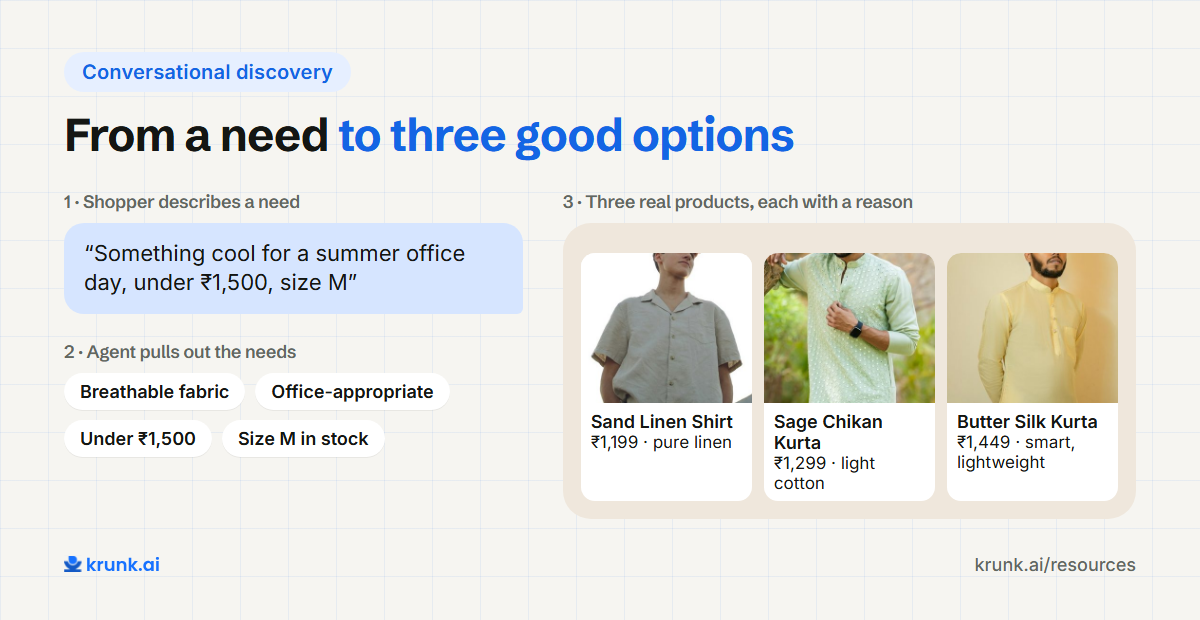
When a shopper writes "something for dry skin under ₹800 that's safe in pregnancy", a good AI agent:
- Pulls out the needs: skin type = dry, budget = under ₹800, constraint = pregnancy-safe.
- Asks one clarifying question if needed: "Face or body?" (Not five questions. One.)
- Searches the live catalog on all needs at once: price, ingredients, stock.
- Shows 2–3 products, with a one-line reason for each: "fragrance-free, ceramides, ₹649".
- Answers follow-ups: size, how to use, delivery.
- Says so when nothing fits, rather than pushing the closest thing. And never invents a product claim it can't find in your data.
3. Where it helps most
Conversational discovery earns its keep in categories where choosing is hard:
- Skincare and beauty: skin types, ingredients, concerns.
- Fashion: fit, occasion, fabric, size across brands.
- Gifting: "for my father, likes tea, under ₹2,000".
- Health and nutrition: goals, dietary needs, allergies (with careful guardrails).
- Home and kitchen: size, compatibility, use case.
- Large catalogs: anything over a few hundred products, where filters stop helping.
It also works best on the channels where shoppers already ask questions: WhatsApp, Instagram DMs and website chat. In India especially, shoppers would often rather ask than filter.
4. What it needs from your product data
An AI agent can only recommend what it can read. The single biggest improvement most brands can make costs nothing: clean product data.
- Descriptive titles: "Aloe Face Wash for Oily Skin, 100 ml", not "The Glow One".
- Attributes as fields, not hidden in images: size, colour, material, skin type, ingredients, occasion.
- Every variant with its own stock and price.
- Use cases in the description: who it's for and who it isn't for.
- Clear policies: delivery times, returns, COD.
- Things the agent must never say: medical claims, competitor comparisons, discounts you don't offer.
This is the same data that makes your store readable to outside AI shopping assistants. Is your Shopify store agent-ready? →
5. Measuring it
- Conversations that end with a product link, and how many of those links are clicked.
- Conversion rate of shoppers who chatted compared with those who didn't.
- Average order value of chat-assisted orders.
- "No match" rate: how often the agent couldn't find anything. This tells you which products to add or which data to fix.
- Top unmet needs: what shoppers ask for that you don't sell. Free product research.
Where Krunk fits
Krunk is an AI sales agent that does conversational discovery on WhatsApp, Instagram and your website. It reads your live Shopify catalog, asks a clarifying question when it needs one, shows real products with photos and prices, and hands over to your team when it should.
Next step
See the WhatsApp AI agent →FAQ
What is AI product discovery?
Using AI to help shoppers find the right product from what they describe, instead of only from keywords and filters.
How is it different from product recommendations?
Recommendations suggest products based on what's popular or similar. Conversational discovery starts from what this shopper says they need.
Does conversational discovery replace site search?
No. Shoppers who know exactly what they want still use search. Discovery helps the ones who know the need but not the product.
What do I need to set it up?
An AI agent connected to your live catalog, and product data with clear titles, attributes and stock. Most of the work is cleaning the data.
Will it recommend products that are out of stock?
It shouldn't. A good agent checks live stock and variants before it suggests anything.