Conversational commerce is selling through conversations: a shopper asks a question in a chat, gets a helpful answer, and buys, without leaving the conversation or filling in a long form.
It isn't new. Every kirana store owner who knows your family's usual order is doing conversational commerce. What's new is that it now happens at scale, on WhatsApp, Instagram and website chat, often with an AI agent holding the first part of the conversation.
This guide explains the idea in plain words, the channels, how it works step by step, real patterns from Indian D2C, and how to start.
In this guide:
- A simple definition
- Why it matters in India
- The channels
- How a conversational sale works
- Examples from Indian D2C
- Who holds the conversation: people, bots or agents
- How to start
- FAQ
1. A simple definition
Conversational commerce is any buying journey where a conversation (in chat, on messaging apps, or by voice) does the work that pages, filters and forms usually do.
It covers the whole journey:
- Before buying: questions, recommendations, comparisons.
- Buying: a product link, a cart, a payment link.
- After buying: order updates, "where is my order?", returns, reorders.
The term was popularised by Chris Messina in a January 2015 blog post. It's sometimes called chat commerce, and when it happens mostly on WhatsApp in India, WhatsApp commerce. WhatsApp commerce in India: the 2026 guide →
2. Why it matters in India
- Messaging is where people already are. India is WhatsApp's largest market, with more than 500 million users according to Meta, and Instagram DMs are how many shoppers first talk to a brand.
- Shoppers like to ask. "Price?", "COD available?", "Will it fit?" Asking feels safer than guessing, especially for a new brand.
- Trust is earned in conversation. A real, quick answer does more for a first-time buyer than any badge on the website.
- Hinglish and regional languages are easier in a chat than in a rigid website flow.
3. The channels
| Channel | Best for | Notes |
|---|---|---|
| Questions, order updates, cart recovery, reorders | Needs the WhatsApp Business Platform for automation | |
| Instagram DMs | Shoppers coming from reels, posts and stories | "Price?" DMs; comment-to-DM campaigns |
| Website chat | Shoppers on a product page with a question | Catches people before they leave |
| Voice assistants and AI shopping agents | Emerging | AI assistants that shop on the customer's behalf Read about agentic commerce → |
4. How a conversational sale works
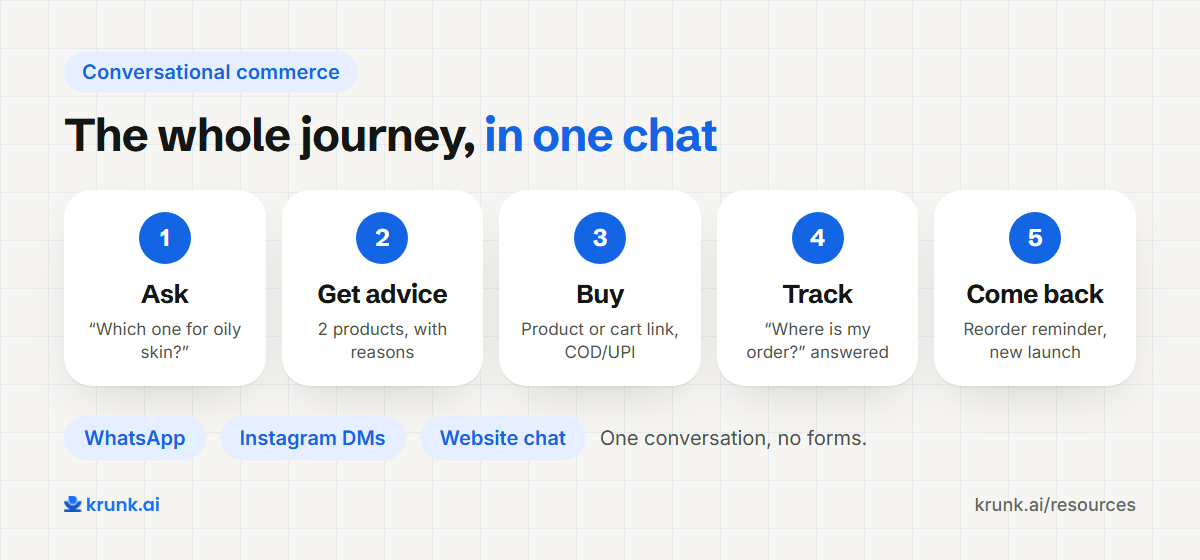
A typical WhatsApp conversation for a skincare brand:
- Shopper: "Hi, I have oily skin and get breakouts. What should I use?"
- Agent: asks one question ("Face wash, serum or moisturiser?"), then suggests two in-stock products with prices and a short reason for each.
- Shopper: "Is the gel one okay with my retinol?"
- Agent: answers from the product information, with a safe "check with your dermatologist if unsure" where needed.
- Shopper: "OK, COD?"
- Agent: confirms COD, sends the product link or a cart link.
- After the order: an automatic WhatsApp update when it ships, and a reply to "where is it?" three days later.
No forms. No search. One conversation.
5. Examples from Indian D2C
These are common patterns we see across the brands we work with:
- Fashion brand, Instagram-first: reels drive "price?" and "size?" DMs; an agent answers instantly with the variant link, and the team handles exchanges.
- Skincare brand on WhatsApp: most chats are "which one for my skin?"; the agent recommends from the catalog, and chat-assisted orders come in at up to 33% higher average order value.
- Food / gifting brand during festivals: order volume spikes before Diwali; WhatsApp updates and an agent handling "will it reach by Friday?" keep the support team from drowning.
- Home brand with COD: a WhatsApp confirmation message after each COD order cuts refusals at the door.
6. Who holds the conversation: people, bots or agents
| People | Menu bot | AI sales agent | |
|---|---|---|---|
| Understands any question | ✓ | ✗ | ✓ |
| Available 24/7 | ✗ | ✓ | ✓ |
| Knows live stock and orders | If they check | Partly | ✓ (when connected) |
| Handles complaints well | ✓ | ✗ | Hands over to people |
| Cost per conversation | Highest | Lowest | Low |
The setup most brands land on: an AI agent answers first, people handle what needs judgement. WhatsApp chatbot vs AI sales agent →
7. How to start
- Read your last 100 chats. What do shoppers ask most? That's your starting list.
- Pick one channel where most of those chats happen (usually WhatsApp or Instagram).
- Fix your product data and policies so answers are accurate. AI product discovery: what your data needs →
- Add an AI agent connected to your catalog and orders, with clear rules and a handover to your team.
- Measure orders, not messages: conversion of shoppers who chatted, revenue from chat-assisted orders, first reply time.
Next step
See how Krunk sells on WhatsApp →FAQ
What is conversational commerce in simple words?
Selling through chat. The shopper asks, gets a helpful answer and buys, all in a conversation on WhatsApp, Instagram or your website.
What is an example of conversational commerce?
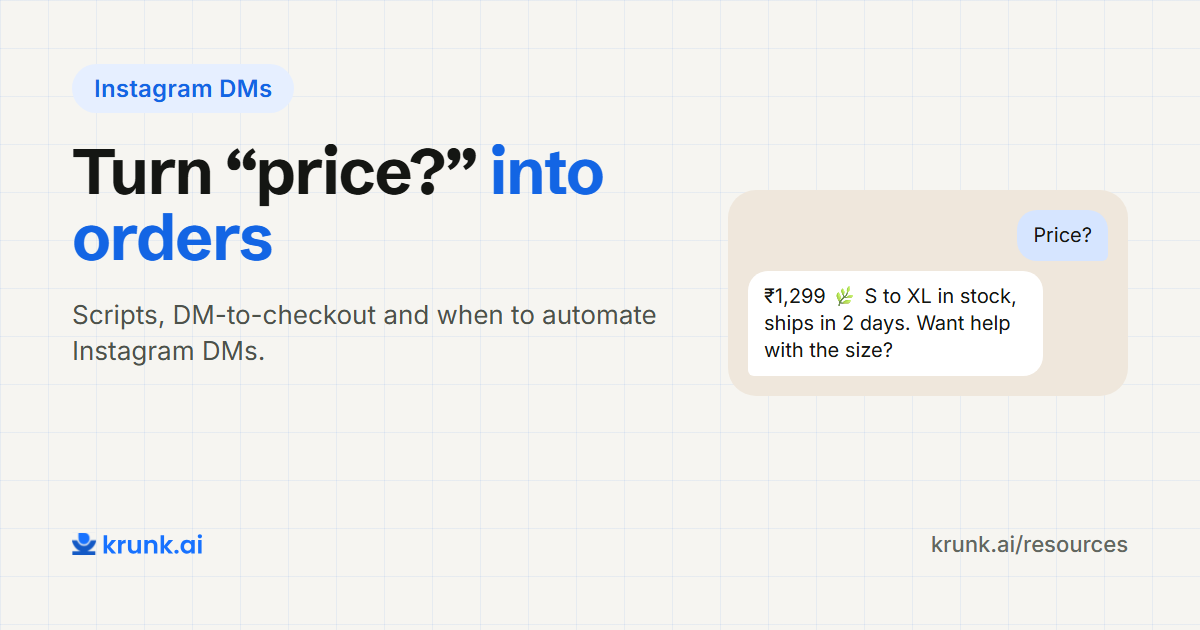
A shopper DMs "price?" on Instagram, gets the price, size availability and a link instantly, and orders. Or a WhatsApp chat where an agent recommends a face wash and sends the cart link.
Is conversational commerce the same as a chatbot?
No. A chatbot is one tool for it. Conversational commerce is the whole way of selling, which can involve people, bots and AI agents.
What are conversational commerce platforms?
Tools that let brands run sales conversations on messaging channels: WhatsApp inboxes, chat tools and AI sales agents. Best AI chatbots for ecommerce, compared →
Is conversational commerce only for big brands?
No. Small brands often do it best, because they already talk to customers on WhatsApp. Automation helps them keep doing it as they grow.